
Portland Head Lighthouse
Cape Elizabeth, ME
PORTLAND HEAD LIGHTHOUSE
A BRIEF SUMMARY OF PORTLAND HEAD LIGHTHOUSE
This iconic landmark is, in my opinion, the most picturesque lighthouse in the United States. I would consider this a must-visit if you are a photographer in the Portland, Maine area. Even though only 5 miles from Portland, the surrounding 90 acres and rugged coastline that make up Fort Williams Park make it feel very far removed. Built-in 1791 this is Maine’s oldest lighthouse and still an active navigation aid for vessels in the Gulf of Maine.
There are no bad angles here and with numerous trails to explore, photogenic rocks and the unpredictable open ocean a photographer could come here almost every day without ever getting bored. Of course, you will not be alone especially midday and for the best light opportunities have to be watchful of the park’s closing hours. I prefer this location for sunrise for multiple reasons but photographically you can take wonderful pictures here at sunset or throughout most of the daylight hours.
Photos and location summary by Matt Reynolds.

Annual Subscription
Lifetime Membership
DATA POINTS INCLUDED WITH PORTLAND HEAD LIGHTHOUSE SUMMARY
This location has many photo opportunities with the difficulty of reaching them ranging from easy to moderate depending on which you choose.
Directly from the parking lot, you can capture the typical postcard scene of the lighthouse, or you can choose to find your composition out on the rocks on either side. There are groomed dirt trails on both sides of the lighthouse which lead around to the areas of rocks. I advise walking around the visible fencing rather than over it! All of the rocky areas have unpredictable waves and slick rocks so this can be dangerous and would be done at your own risk.
Besides the lighthouse, the surrounding park has numerous walking trails so don’t be afraid to explore and find other photographic opportunities without the main lighthouse in the frame. The park was a former WWI and WWII military fort and there is even a beach area, playground, soccer field, and children’s garden so plenty to do and see for any non-photographers that may be in your party.
The town of Cape Elizabeth owns the park and maintains the trails, a non-profit organization, Friends of Williams Park, supports the park’s ecology and accessibility for visitors. Please respect the parks' natural resources when visiting so it can be maintained for future generations to enjoy as well.
I mentioned above the seasonal aspects, camera settings, choice of lens, etc.…
There truly are numerous locations where you can photograph this lighthouse. The traditional view is from the parking lot, just west and slightly south of the lighthouse. This area has a fence in front.
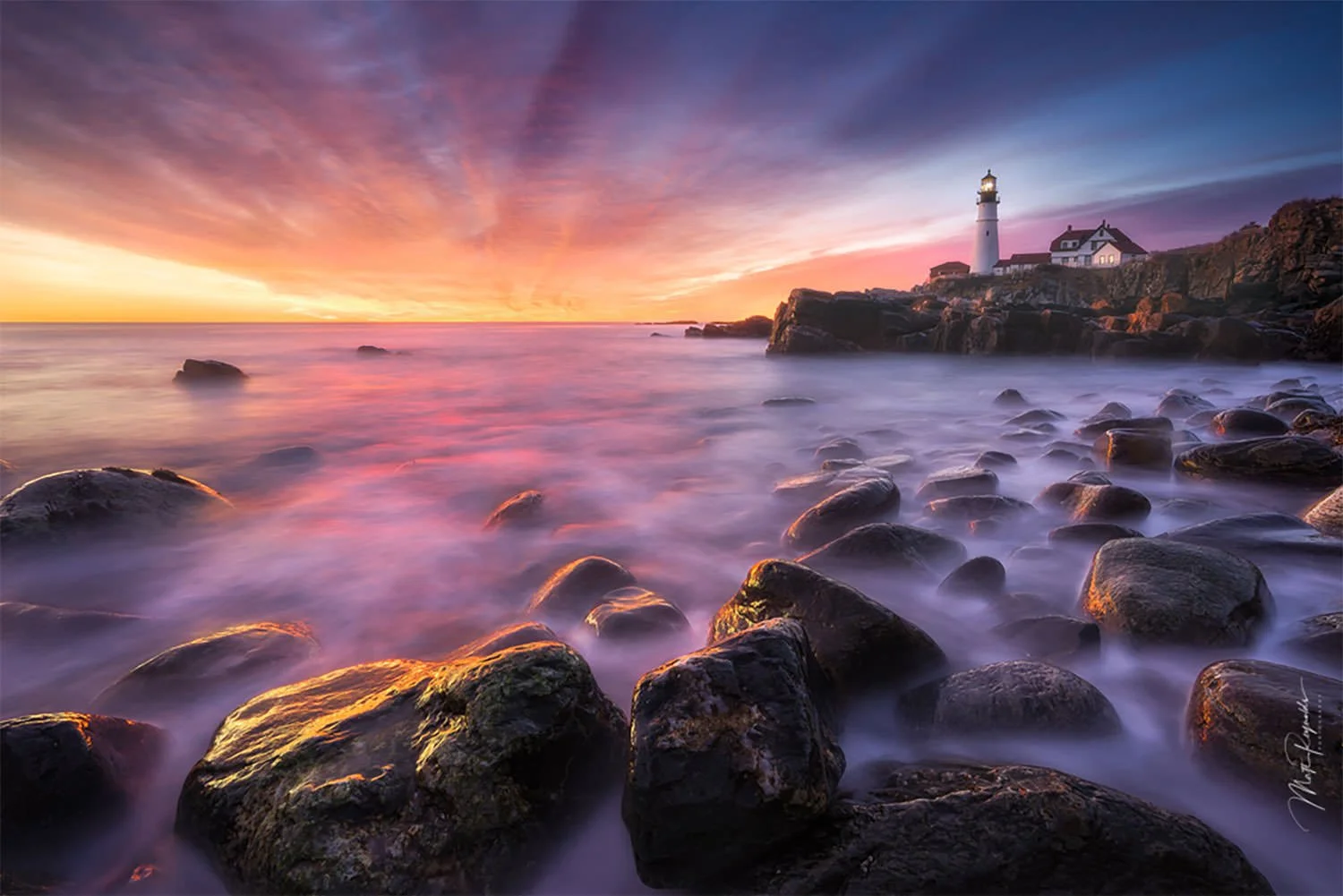
The image above is the most dramatic cliff view from the north on the rocks looking toward the lighthouse, this area is reached via the walking trails that head north past the lighthouse. Once reaching this point, venture down to the cliff edge out onto the rocks as far as the tidal conditions allow. There are other points further north from this area as well as you …
Know the Tide
From a photography (and safety), tidal differences can be significant. For location #1, I usually prefer lower tides to enable a photo from the rocks below the cliffs. For location #2 can look best at high tides.
Click here for the tide chart for the Portland Head Lighthouse.
Click here to view the Portland Head Lighthouse webcam (for current conditions).
This Portland Head Lighthouse is primarily a wide-angle location.
The rocks and the wild Atlantic Ocean are the main foreground elements to seek out. If the conditions allow, you can get close to some nice directional foreground rocks being touched by the ocean. With a wide-angle lens, the rocks are more prominent and the lighthouse is large enough to not suffer from being a distant subject. IMPORTANT: if the waves are rough, for safety reasons should not venture to the shoreline and should stay on top of the larger rocks or even behind the fencing.
If the waves are very rough, you can photograph the waves and lighthouse with a normal or even longer focal length to bring the crashing waves closer to you and have the lighthouse appear even larger in the frame.
In the summer months look for the varying wildflowers as potential foreground elements. The beach roses in the later summer periods bloom right next to the rocks.
For waterscapes, I find the timing to capture the receding wave is your best chance of capturing water on the rocks. Normally I prefer to capture the movement of water as it recedes (with shutter speeds between 1/10th – 1-second). However, for this location, I find longer exposures work best. A remote shutter is very helpful and this is a good place to experiment with different shutter speeds.
The image above was taken @ 16mm on a 16-35mm lens on a full-frame camera facing south. I used f13 to keep the rock close to me in focus and 20-sec shutter speed to smooth out the water and surf over the rocks. This image was taken 20 minutes before sunrise. Less than one minute after taking this photo an incoming wave knocked over my tripod and camera. Fortunately, I caught the camera before it crashed and decided it was time to reposition myself for the actual sunrise as the tide was coming in.
Sea Level Ft. Elevation
Other Resources Available with Membership
Detailed Directions
Best Time of Day to Shoot
Best Time of Year to Shoot
Equipment Needed
Required Permits
KMZ Trail File
Direction of Shot
Google Maps Birds-Eye-View
Number of Photographers to Expect
Cell Service
Current Weather
Lodging & Camping
Area Guides and Workshops
Other Resources
LOCATION SUMMARIES WRITTEN BY PROFESSIONAL PHOTOGRAPHERS


